
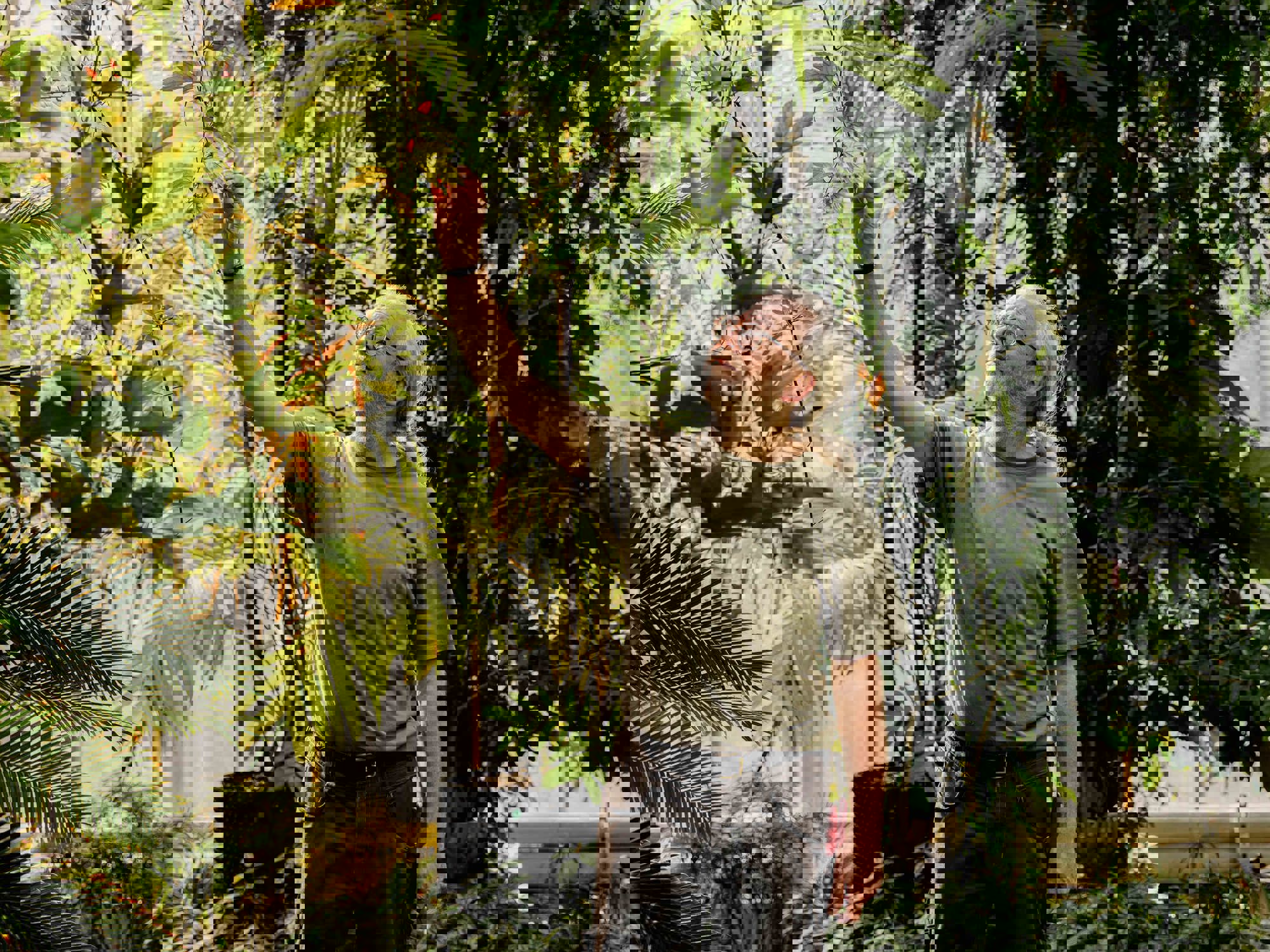
The Glasshouses
Our Glasshouses - including the Palm Houses and Front Range Glasshouses – are currently closed as part of Edinburgh Biomes, the Garden’s landmark restoration and development project.
-
Safeguarding the future
The Royal Botanic Garden Edinburgh is home to some of the world’s rarest and most threatened plants, with a third of the collection growing in the Glasshouses.
To protect this globally important plant collection, the celebrated Grade A Listed public Glasshouses are currently closed for major restoration as part of the Edinburgh Biomes project.
The first stage of this programme, the restoration of our Georgian and Victorian-era Palm Houses is nearing completion, and will reopen to the public in the latter part of 2026.
Stay up to date with progress on our Palm Houses and read our behind-the-scenes blog, Stories from the Biomes.
Treasures Under Glass
Watch the short film below to discover more about our precious collection of conservation plants growing under glass.
Treasures Under Glass
Filmed in 2020.
| Time | Description |
| [Narrator] The Royal Botanic Garden Edinburgh has a precious and world-leading collection of plants. The environments created under glass allow important research and conservation work. The horticulture team look after the plants 365 days a year. | |
| [Louise Galloway, Glasshouse Supervisor] It never ceases to amaze me, that in our glass houses, we grow over a third of all the living collections. That's over 45,000 plants in a space the size of just over a football pitch. We have a number of conservation collections where we hold rare and endangered plants from around the world, and botanic gardens are increasingly important to safeguard and grow these endangered plants. | |
| [Narrator] Many thousands of visitors tour the public glass houses. Even on a dark day in winter, bright colours of tropical species are there to enjoy, but many plants will face extinction unless they continue to be conserved here. | |
| [Mark Hughes, Begonia Systematist]This is Begonia samharensis, one of the rarest plants in the world, and this occurs on the top of a very small island called Samhar in the Northern Indian Ocean, and indeed, its stronghold of distribution is now in the glass houses here in Edinburgh. | |
| [Narrator] Scientists from Edinburgh explore richly diverse areas of the tropics to research begonias, always in partnership with botanists from host countries. With many Begonia species rare or not cultivated elsewhere, the Botanics can be the only place to see them. | |
| [Mark Hughes] The Botanics, our mission statement is to explore, conserve and explain the world of plants, and with the Begonia collection, we're doing all of those things, absolutely. We've built up this collection through targeting areas that are really, really diverse. So having this different collection here, this is a real privilege. We can look at Begonias actually, as canaries of the forest, if you like, because they have such tiny distributions, they are really indicative of the health of that particular part of the forest. They're much more easily lost due to logging or climate change, for example. So therefore, it's really important that they have a home here in the Botanics. | |
| [Narrator] On expedition to the Island of Sulawesi, the Royal Botanic Garden and partners from Indonesia work on taxonomy and conservation of the island's diverse flora. Every species they study, the garden leaves specimens and plants in the care of botanic gardens there before conserving them in Edinburgh. | |
| [Hannah Atkins, Gesneraceae Taxonomist] The Royal Botanic Garden, Edinburgh is very fortunate in having dedicated horticultural staff who specialise in particular collections. Sometimes the plants that we've travelled miles to study are not flowering or fruiting, they're sterile. So the great advantage of having horticultural staff is that they can take cuttings, keep them alive in the field, bring them back to the glass houses here, and only then when we grow them here and they flower and fruit, we can find out what they are. | |
| [Narrator] Excitement rises in one of Edinburgh's humid glass houses after the towering species, Amorphophallus blooms. From only a bud, the plant has grown by centimetres, sometimes in a day. | |
| [Paulina Maciejewska-Daruk, Horticulturist] You can see how high I need to actually climb to do this. Do you know how tall the plant was? Yes, 273, that was last measurement at one o'clock. | |
| [Narrator] In Sumatra, Indonesia, they call it corpse flower from its smell. The spadix of the plant heats up. The hot air rises, dispersing a stench over the jungle. | |
| [Peter Wilkie, Sapotaecea Systematist] It just heats up to help get the smell out to attract pollinators. It's amazing how much energy a plant will put out just to get pollinated, but that whole structure is just for pollination. | |
| [Narrator] From high in the glass house to wading through water... | |
| [Horticulturist at work] I've got it. | |
| [Narrator] Skills of horticulture again, this time among the lilies. A weekly health check to protect these beautiful species against pests and pathogens. In glass houses, some over 150 years old, treasures under glass that are a snapshot of tropical and subtropical regions of the world, cared for by Royal Botanic Gardens staff vital to everyone's future. | |
| [Simon Milne, Regius Keeper] You got an incredible resource, not just for Scotland or the United Kingdom, but for the world, addressing so many of today's problems, but particularly addressing the issue of protecting the natural capital that we have around the world, and not just to admire the beauty of the plants and have the big lilies growing in the pond and the palms and all those very impressive species. But it's also about looking at those plants, which we use every day and benefit from every day, cocoa, tea, chocolate. So it's also about discovering the use of plants as well as admiring their beauty. So it is the place to visit in Edinburgh without a doubt. |
The Glasshouse Range
Discover more
Palm Houses
-
Now fully restored, the Palm Houses have been unified into one large, temperate space.
Towering palms and lush ferns will play a key role in the new planting plan, inspired by pteridomania, the Victorian passion for all things fern-related. The 600 botanical specimens will include an understorey of delicate begonias, one of the main areas of botanical research in the Garden, as well as many other species.
Plants and People House
-
Here luxuriant tropical rainforest vegetation and economical plants - including bananas, rice, sugar and cocoa - surround the central pond.
In the summer the pond is dominated by the huge floating leaves of the giant water lily (Victoria species), which thrives in the high humidity and hot conditions of this house.
Although giant water lily plants is a perennial in the wild, they cannot be sustained all year round so far north due to the low winter light levels. Instead, fresh seed is sown each year in January to produce new plants.
Orchids and Cycads House
-
A smaller individual example of the 1967’s Front Range, this glasshouse was opened the following year and dominated by cycads. They have tough palm-like leaves, and both the male and female plants bear spectacular cones. Cycads are very slow growing, surviving for up to 2,000 years, although unfortunately in their native habitats many are threatened with extinction. Some of the cycads in this house are already over 200 years old.
A wide range of orchids flourishes in the moderate humidity and warmth of this house. Some, known as terrestrial orchids, are rooted in the ground, but many others grow epiphytically - on the surfaces of other plants.
Ferns and Fossils House
-
The grove of tree ferns around the cascading stream in the centre of the house echoes the montane cloud forests of temperate Australasia. These tall-growing species, which can reach up to 20 metres, provide shelter for other delicate species and under-storey ferns that demand protection from high light levels. You will also find a giant horsetail (Equisetum myriochaetum) here - it's as invasive as the garden weed and is contained within a concrete planter.
Look out for a replica of Westlothiana lizzae (created by Mo Farquharson), a 25cm long lizard-like reptile that lived in the swamps in central Scotland some 338 million years ago and also Acmopyle pancheri, endemic to New Caledonia, and now under threat as populations become fragmented by mining activities and fire.
Rainforest Riches House
-
Experience the hot and humid atmosphere of the South American rainforest. A range of exotic climbers, many of which have extraordinary flowers, festoons the walls and railings that overlook the pool brimming with carp.
Featuring prominently are the bromeliads - a large family of over 2,000 species, of which the most familiar is the fragrant pineapple (Ananas comosus). Known as 'urn plants', their leaves spiral around a central hollow in a nest shape, storing water for the plants and creating a reservoir for other life forms, such as the tree frog.
In late winter the bright red pompom flowers of the Calliandra haematocephala provide a splash of colour.
Temperate Lands House
-
The great expanse of this house is a direct result of the external supports designed into the Front Range by the architects for the Department of the Environment in 1967; the design maximises the light available to the plants and provides a pillar-free internal area which is landscaped to create an atmosphere of exotic habitats.
The bridge that stretches end to end gives wonderful views down onto the lower level.
The house features plants from warm, moist evergreen forests, such as the Japanese blue oak (Quercus glauca) and the kauri (Agathis australis).
Beneath these are many shade-loving plants such as begonias, hedychiums and ferns, which thrive in the dappled shade.
Arid Lands House
-
The clear, dry air of the Arid Lands House transports you to desert regions of the world, from the Americas to Africa and Arabia.
The displays in the house explore the complex ecosystems of desert life; the plants are xerophytes, which have adapted in various ways to show extraordinary tolerance of dry conditions.
Some, such as Agave and Aloe, have fleshy leaves in which water is stored, while Cacti have leaves that are nothing more than spines, while others like the ferns shrivel up like a nest of dry leaves.
In summer, the sandstone in the house absorbs the heat in the day and releases it at night when these areas can drop to freezing temperatures. The plants benefit from this heat, as well as from the shade that helps with water conservation.
Montane Tropics House
-
North of the Front Range is the first of the two clear-span glasshouses that opened in 1978 and are landscaped to reflect the scientific collection of SE Asia. Here the higher altitude plants thrive in a cool moist & bright atmosphere.
The first glasshouse represents the mountainous region of Borneo to Indonesia, which is home to the world's richest diversity and largest collection of Vireya rhododendrons. These beautiful plants can be found growing from sea level to over 4,000m in the wild yet are not frost hardy and need to be grown under glass.
A case of carnivorous plants is another popular attraction in this house. Look out for the cobra lily (Darlingtonia californica) and the Venus flytrap (Dionaea muscipula).
Lowland Tropics House
-
In the second of our clear-span glasshouses we stay in the same geographical area as the Montane Tropics House, but this environment represents the lowlands and so it is warmer and wetter.
The limestone cliff provides the environment for members of the African violet family, the Gesneriaceae, within which are plants such as the goldfish plant (Columnea) and the lipstick vine (Aeschynanthus).
Dominant here is the large collection of gingers, the Zingiberaceae. Many species of this family have leaves that contain aromatic oils and the family includes culinary plants such as turmeric and cardamom as well as the familiar ginger Zingiber officinale.
At the back of the house is a 1000-litre pot containing the tuber of the now-famous Amorphophallus titanum, the world's biggest and smelliest unbranched inflorescence. The plant flowered for the first time in Scotland in June 2015 when it flowered for the second time it was pollinated and went on to produce the first seed from Scotland.
Chilean Terrace
Fossil Courtyard
-
Discovered about a mile from here at Craigleith Quarry, Pitus withami grew in swamp forests during the Carboniferous Period 320-340 million years ago. Unfortunately, it has no close living relatives.
Behind is the fossilised root of a Lepidodendron, or scale tree, which could grow up to 45 metres. Its only living relatives are the small, trailing clubmosses ntive of Scotland, norther Europe and North America.
Glasshouse Borders
-
Although not covered in glass, the Glasshouse Borders enjoy a microclimate that allows more tender plants to survive outside, thanks to the protection the proximity of the glasshouses provides.