

Ahead of Earth Day later this month, the Royal Botanic Garden Edinburgh today (Wednesday, April 1) celebrated world leading collaborations in plant science and horticulture with Japan through the planting of a young cherry tree (Prunus x yedoensis) by the Consul General of Japan, Mr Katsutoshi Takeda, on behalf of the people of Japan.
Donated by the Sakura Cherry Tree Project, the sapling is one of 10 plants to be planted along Sakura Brae - a scenic avenue of cherry trees, currently in full blossom. Representing three separate species (Prunus x yedoensis, Prunus ‘Tai-haku’ and Prunus ‘Beni Yutaka’), as the trees mature, they will create an even more spectacular canopy of white and pink blossom each spring, creating a new focal point for visitors.
A further 38 trees will be sent to two of the other three gardens that make up the Royal Botanic Garden Edinburgh - namely Benmore Botanic Garden in Argyll and Dawyck Botanic Garden in the Scottish Borders.
Dr Julia Knights, Regius Keeper of the Royal Botanic Garden Edinburgh said: “At a time when global collaboration is more important than ever, these stunning cherry trees, donated by the Sakura Cherry Tree Project, symbolise the power of plant diplomacy, and celebrate our strong partnerships in plant science and conservation horticulture with our partners in Japan.
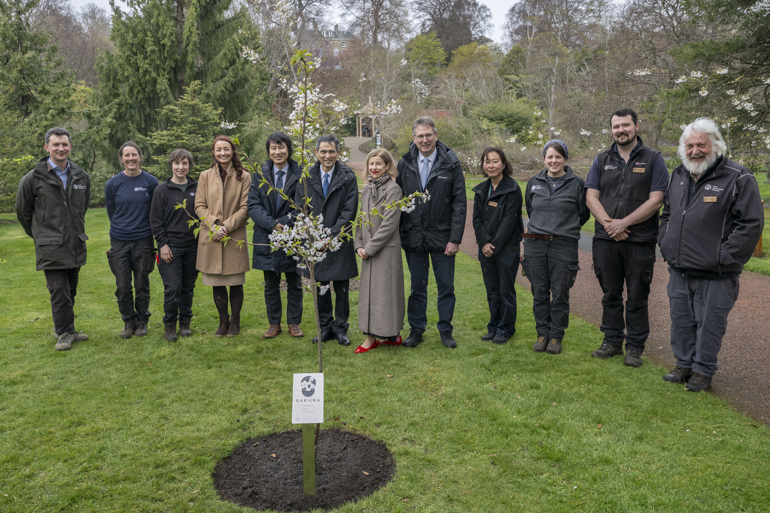
Mr Katsutoshi Takeda, Head of Mission at the Consulate General of Japan added: “I am delighted ten new Sakura cherry trees are being planted at RBGE as part of the Sakura Cherry Tree Project which has seen over 8000 Japanese cherry trees planted in the UK. These trees are a symbol of the deep-rooted friendship between Japan and the UK, and it gives me great pleasure to know that their beautiful blossom will be enjoyed by visitors to the garden for many years to come”.
Launched in 2019 by Keisaku Sandy Sano, Chairman of the Sakura Cherry Tree Project, the programme initially intended to distribute 1,000 trees across the four nations of the UK. After captivating the public’s imagination, the target was quickly surpassed, with more than 8,000 specimens now planted and an ambitious new goal of 10,000 trees set.
The trees have been donated by Japanese businesses and individuals to symbolise the enduring friendship between Japan and the UK, creating a wave of cherry blossom from the Orkneys to Cornwall. Sakura Brae is named after the Japanese word for cherry blossom.
Ends
For further information, interviews, or images, please respond to this email or contact Suzie Huggins on 07385 491 460 or Shauna Hay on 07824 529 028.
Editor's notes
The project is a legacy from the Japan-UK Season of Culture 2019-2021, which aimed to showcase Japan’s multifaceted attractions in the UK. The gift of these trees enables people to learn more about Japan, its culture and traditions. It is the intention of this project to plant across the whole of the United Kingdom so that each spring there is a wave of cherry blossom across the country.
All of the varieties of cherry trees to be planted as part of this project are of Japanese origin. The vast majority will be of three varieties, ‘Beni-yutaka’, ‘Tai Haku’, and ‘Somei-Yoshino’, which have been chosen for their variation in colour, timing, and historical significance. For example, ‘Tai haku’ is a large, single white blossom variety, which became extinct in Japan but was reintroduced to its homeland by Britain’s Collingwood 'Cherry' Ingram in 1932.
The renowned Japanese artist, Kenya Hara has provided the design of the commemorative certificates. This permanent and lasting symbol of the enduring friendship between the UK and Japan is entirely funded by Japanese businesses and individuals and managed by the Sakura Cherry Tree Project team.
Royal Botanic Garden Edinburgh’s partnerships with Japan
The Royal Botanic Garden Edinburgh continues to develop strong international plant science and conservation horticulture partnerships with counterparts in Japan, with the most recent fieldwork taking place on Japan’s main island of Honshu in September 2025.
Collaborating with botanists from the University of Tokyo, Garden Horticulturists Richard Brown and Andrew Ensoll collected specimens from a wide range of species endemic to Japan, including ferns, magnolias and alpine plants.
Now germinating in the organisation’s Nursery facilities, in time the young plants will join the Garden’s Living Collection and be planted out in Edinburgh, Benmore Botanic Garden in Argyll, Logan Botanic Garden in Dumfries & Galloway and Dawyck Botanic Garden in the Scottish Borders.
Royal Botanic Garden Edinburgh (RBGE) is a leading international research organisation delivering knowledge, education and plant conservation action around the world.
In Scotland, its four Gardens at Edinburgh, Benmore, Logan and Dawyck attract nearly a million visitors each year. It operates as a Non-Departmental Public Body established under the National Heritage (Scotland) Act 1985, principally funded by the Scottish Government. It is also a registered charity, managed by a Board of Trustees appointed by Ministers. Its mission is “To explore, conserve and explain the world of plants.”